

It’s late, and you’re staring at your online banking. Your HELOC balance sits right next to your regular mortgage. Now a job change, divorce, or missed payments means you need to move. So the question hits: can you even sell your house with a HELOC still open?
You usually can sell a South Carolina house with a HELOC. The line simply gets paid off at closing, along with your main mortgage. The real question is whether your sale price covers both loans and closing costs. That math is where most of the stress comes from.
This guide explains how payoffs work at a South Carolina closing and what to do when numbers are tight. It also shows where a local cash buyer can simplify the payoff math and the timing. It’s written in plain English, the way we’d explain it at your kitchen table.
Picture yourself in your Columbia or Greenville living room, looking at two balances on your phone. It’s easy to assume two loans on one house means you’re stuck. You’re not, but it helps to know what a HELOC really is.
A home equity line of credit is a revolving line of credit secured by your house. The CFPB explains how a HELOC differs from a home equity loan, likening it to a credit card. If you already have a mortgage, the HELOC usually sits behind it as a second lien.
| Loan type | How it works | What happens when you sell |
| Traditional mortgage | One fixed loan with a set payment schedule. | One payoff clears the lien. |
| Home equity loan | A second fixed loan, paid out as a lump sum. | A second payoff, but the balance is predictable. |
| HELOC | A flexible line you can draw from and repay. | A second payoff that changes with draws, interest, and fees. |
| Reverse mortgage | A loan for older owners that grows over time. | Usually comes due at sale, so payoff drives your net. |
Every one of these is a recorded lien. For a clean sale, liens get paid off so the buyer receives clear title. A HELOC adds a moving target because the balance shifts with draws and interest.
Having a HELOC does not automatically block a sale. Lenders don’t forbid selling; they simply expect repayment from the proceeds.
Only your lender and loan documents spell out your exact HELOC rules. This article isn’t legal advice, so confirm details with a South Carolina attorney. Have a reverse mortgage instead? Read the CFPB’s reverse mortgage basics and our guide to selling a home with a reverse mortgage in South Carolina.

Maybe you’re holding a listing agreement, worried a buyer will bail the moment they hear second mortgage. Here’s the short answer. In South Carolina, you can usually sell with an active HELOC if the payoff is satisfied at closing.
In this attorney-closing state, the South Carolina Bar outlines supervision rules for real estate closings. Those rules cover title, documents, closing, recording, and disbursing. Your closing attorney coordinates payoffs to both your first mortgage and your HELOC.
| Step | What happens | Your role |
| 1. Payoff request | The closing attorney requests a payoff quote from your HELOC lender. | Share your lender contact and account details. |
| 2. Payoff quote | The lender lists principal, interest to a set date, and any fees. | Stop drawing on the line. |
| 3. Closing day | The attorney wires both payoffs directly from the sale proceeds. | Review the settlement statement and sign. |
| 4. Lien release | The lender releases its lien so the buyer gets clear title. | Keep copies of the payoff confirmation. |
A payoff quote is your lender’s written snapshot of what clears the HELOC by a certain date. It’s often higher than your last statement because it adds interest and fees.
• Bring cash to closing if that’s realistic for your budget.
• Ask about a negotiated or short payoff, which needs lender approval and may affect taxes or credit.
• Change your strategy, such as selling directly to a cash buyer used to working with lienholders.
• Pause and rethink timing if waiting a few months would let you pay the line down.
Handled early, a HELOC payoff is mostly math and paperwork happening behind the scenes. The number that matters most is your net proceeds, not the headline price. Early planning keeps closing day calm. Before agreeing to any short payoff, talk with your lender and a South Carolina attorney.
You’re at the kitchen table in Charleston or Spartanburg, scratch pad out, unsure who to call first. A simple checklist makes the whole process feel far more manageable. Work through these steps in order, and keep notes as you go.
1. Gather your numbers. List your mortgage balance, HELOC balance, credit limit, rates, and recent draws. Add a rough home value based on recent nearby sales.
2. Call your HELOC lender. Ask how to request a payoff quote and whether early-closure fees apply. Also ask how long each quote stays valid.
3. Decide how you’ll sell. A traditional listing may bring more money but means repairs, showings, and financing risk. An as-is sale to a local cash buyer is simpler and often quicker.
4. Request payoff letters for both loans. Once you’re under contract, the closing attorney orders payoff letters from each lender. These letters show exactly what each lender needs to release its lien.
5. Get a net proceeds estimate in writing. Ask the attorney for a net-to-seller sheet showing price, payoffs, and closing costs. Seeing the whole stack beats guessing every time.
6. Close and let the attorney disburse funds. The attorney wires both payoffs and sends you whatever remains. If there’s a shortage, they’ll explain how much you must bring.
For mortgages, federal rules generally require servicers to send a payoff statement within seven business days of a written request. HELOC lenders may follow their own processes, so ask yours directly. Contract-to-close often runs a few weeks to a month or more, though nothing is guaranteed.
Lenders control payoff timelines and fees, not you or the buyer. A Charleston seller packing for a relocation can lean on this list to avoid missed steps. Keep circling back to your net after both payoffs, not the offer price.
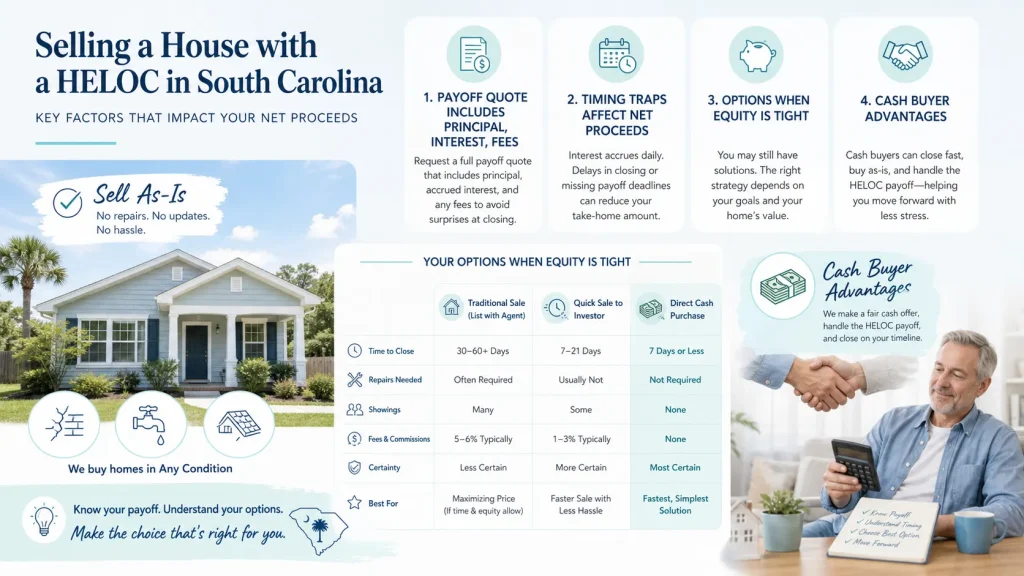
You expected about $20,000 from your sale. Then the HELOC payoff quote arrives several thousand dollars higher than your last statement. Most of the time, that jump is simply how payoff math works.
• Outstanding principal: what you’ve borrowed and not yet repaid.
• Accrued interest: interest building between your last statement and the payoff date.
• Fees: early-closure, recording, processing, or other line-specific charges.
Payoff quotes expire on a set date. If closing slides, the attorney orders a fresh quote and interest keeps growing. Ask the attorney to confirm each quote’s good-through date.
• Drawing on the HELOC after you list, which quietly eats your equity.
• Skipping payments before closing, which stacks late fees into the payoff.
• Relying on an old payoff quote when you sign, then facing a higher number.
Here’s a hypothetical example with round numbers. It shows how a small payoff change hits your final check. These figures are illustrations only, not market data.
| Line item | Original estimate | After a payoff increase |
| Sale price | $300,000 | $300,000 |
| First-mortgage payoff | –$220,000 | –$220,000 |
| HELOC payoff | –$40,000 | –$45,000 |
| Closing costs and other items | –$10,000 | –$10,000 |
| Net proceeds | $30,000 | $25,000 |
Nothing changed on the price, yet your net shrank by $5,000. A Rock Hill seller whose buyer’s financing slips a week can feel this. The exact formulas and penalties live in your HELOC agreement, so confirm details with your lender.
Fewer moving pieces make payoff dates easier to hit cleanly. That’s one reason a cash sale often feels calmer and more predictable. For the cost side of this math, see our breakdown of seller closing costs in South Carolina.
Now you’re reading a draft settlement statement from a Columbia attorney’s office. Line after line appears: taxes, attorney fees, recording charges, and HOA dues. It’s natural to wonder if anything will be left.
• Attorney-led closings are the norm. A local attorney coordinates every payoff and records the deed.
• Seller closing costs stack up. Expect attorney fees, title services, recording fees, and the state’s deed stamps transfer tax.
• Profits may be taxable. The IRS explains the home sale exclusion in its guide to selling your home (Topic 701). Check with a tax professional if your gain is large.
• Other liens can ride along. Past-due property taxes, HOA liens, or judgments often appear in title searches. Unpaid taxes can eventually trigger the South Carolina tax sale process.
• HOA statements take time. Ask your HOA early, since the attorney needs current dues figures.
• Everything clears in one transaction. The attorney pays all required liens at closing if proceeds cover them.
Picture an inherited Columbia bungalow with a small HELOC and an old medical judgment. Or a Spartanburg landlord who has fallen behind on HOA dues. Both items land on the settlement sheet right next to the HELOC payoff.
Put simply, true equity is your sale price minus all payoffs, closing costs, and other liens. It’s not an online home value estimate minus your first mortgage. A local as-is buyer can coordinate those multiple payoffs with the attorney for you.
This is the gut-check moment. After both loans and closing costs, there may be almost nothing left. You might even need to bring money to closing that you simply don’t have. Take a breath, because you still have real choices.
Lenders measure this with combined loan-to-value, or CLTV. Add your mortgage and HELOC balances, then divide by your home’s rough current value. The higher that percentage, the thinner your true equity.
| Option | When it fits | Watch out for |
| Wait and pay down the HELOC | You have a flexible timeline and steady income. | Interest keeps accruing while you wait. |
| Bring money to closing | Savings or family help can cover the gap. | It ties up cash you may need for moving. |
| Rent the property | Rent covers the mortgage and HELOC payments. | Landlord duties, repairs, and vacancy risk. |
| Short sale or negotiated payoff | The sale price falls below what you owe. | Requires written lender approval and may affect taxes or credit. |
| Direct sale to a cash buyer | Value covers liens and costs, and time matters. | The price must still clear required payoffs. |
Real life adds twists like a relocation deadline, a divorce, or missed HELOC payments. Doing nothing still costs you in interest, late fees, and stress. If you’re already behind, review our South Carolina foreclosure timeline to understand your clock.
No. Most sellers pay the HELOC at closing from sale proceeds. The closing attorney orders a payoff quote near closing and wires funds directly. Avoid new draws during the sale, since they raise the payoff.
Often, yes. Late fees and past-due amounts get rolled into the payoff at closing. Acting quickly with your lender and a closing attorney preserves options, because waiting lets interest and fees shrink your equity.
Yes. Tell your agent or buyer upfront, since the HELOC will appear in title work anyway. Early disclosure helps the attorney plan both payoffs and avoid surprises on your settlement statement.
Yes, as long as total payoffs fit within the purchase price or lender-approved terms. High Noon works with South Carolina closing attorneys to pull payoffs, so you see exactly how each loan clears.
Roughly a few weeks once you have a buyer and payoff quotes, though timing isn’t guaranteed. Financed sales often take longer. Speed depends on lender response times and how quickly the attorney clears title.
No. High Noon purchases houses as-is across South Carolina, even with a HELOC in place. The offer accounts for your home’s current condition and loan payoffs from the start.
By now the payoff process makes sense, but juggling it yourself may feel exhausting. A true cash buyer isn’t waiting on bank approval. That means no third-party lender pushing dates around during your HELOC payoff window.
High Noon Home Buyers purchases houses with HELOCs and other liens across South Carolina, with an office in Columbia. For a free, no-obligation look at your payoff numbers, call (803) 784-7672. We’ll walk through the numbers with you, so you can see whether a cash sale clears your HELOC. There’s no obligation, and no pressure to decide on the spot.