

Picture opening a county envelope and finding a tax bill for land you barely knew existed. Your phone buzzes with texts from siblings asking what to do next. Suddenly, you are responsible for property you may never have visited.
The good news is that selling inherited land in South Carolina is possible, even with multiple heirs or probate questions. You need to confirm what you inherited, who must sign, and which sale path fits your family.
High Noon Home Buyers is a local, family-owned team that works with heirs across South Carolina. This guide explains each step in plain English. Use it alongside advice from your South Carolina attorney or tax professional. Nothing here replaces legal or tax advice.
Deed descriptions full of plat references and old legal wording can feel like another language. Yet no buyer can close until the person signing has legal authority to sell. So start with some simple detective work.
Many South Carolina families also hold heirs property. That means land passed down informally, often without a will or an updated deed. The Center for Heirs’ Property Preservation helps families sort out these tangled titles. Clearing heirs property title usually requires legal help.
| How the Land Is Titled | Who Usually Signs | What the Closing Attorney May Request |
| Deceased owner, estate open | Personal Representative | Letters of appointment and possible court approval |
| Several heirs as co-owners | Every titled co-owner | Signatures and IDs from all owners |
| Living or testamentary trust | Trustee | Trust document or trustee certificate |
| LLC or other entity | Manager or managing member | Operating agreement and proof of authority |
| Heirs property, no updated deed | Depends on who legally inherited | Title work and, often, an attorney’s help |
A land sale can only move as fast as the title is clear. If a house sits on the land near Columbia, read our guide on selling an inherited house in Columbia, SC. For trust-owned property, see selling a house in a trust in South Carolina.
Family group texts get heated fast when one cousin refuses to sign. Here is the general rule. For a voluntary sale, every heir listed as an owner on title usually must agree and sign. Unusual deeds or wills can change that, so confirm with your attorney.
Each co-owner typically holds an undivided interest in the whole property, not a specific corner. One heir usually cannot sell the entire tract alone. Buyers will want every titled owner’s signature, or the Personal Representative’s or trustee’s. That rule protects every owner’s share.
If no one can agree, a co-owner may file a partition action. In that court case, a judge divides the land or orders it sold. South Carolina adopted the Uniform Partition of Heirs’ Property Act in 2016, adding protections for heirs property owners. Still, partition takes time, money, and an attorney.
• Buyout: one heir purchases another heir’s share.
• Agreed sale: everyone accepts a price and a simple payout sheet.
• Single written cash offer: one clear number and timeline gives everyone something concrete to discuss.
A written offer with a simple payout breakdown can calm the loudest voices. It turns a fuzzy someday debate into a specific choice. Everyone sees the same number and the same closing date.
Probate is the court process that settles a deceased person’s estate. It confirms any will, identifies heirs, and appoints a Personal Representative. It also oversees paying debts and distributing what remains.
The Personal Representative’s powers come from the will and the South Carolina Probate Code. In many cases, they can sign a contract to sell land during probate. Some sales need heirs’ consent or court approval first. Proceeds usually flow into the estate before heirs receive anything.
Not all land goes through probate. Jointly owned property with survivorship rights or trust-owned land may pass outside the estate. Your attorney can confirm which bucket your parcel falls into.
A local cash buyer can fit into this process instead of complicating it. The buyer can wait for any court approval, then close on the timeline the court allows. That keeps everyone moving toward one closing date. Our Columbia-focused probate process timeline guide explains each stage.
Selling inherited land in South Carolina brings tax questions, but the picture is often brighter than expected. The South Carolina Department of Revenue confirms the state has no estate tax. That applies to deaths on or after January 1, 2005. South Carolina also has no inheritance tax.
Capital gains tax can still apply when you sell. The IRS explains that inherited property’s basis is generally its fair market value on the date of death. This step-up in basis can shrink your taxable gain if you sell soon.
Here is a simple example. A parent bought land for $20,000 decades ago, and it was worth $80,000 at death. If you sell for $82,000, the taxable gain may be closer to $2,000 than $62,000.
| Cost Item | What to Expect |
| Back property taxes | Unpaid taxes, penalties, and interest are usually paid at or before closing |
| Closing attorney and title fees | Title search, deed preparation, and recording work |
| Recording and transfer charges | County fees to record the deed and handle transfer paperwork |
| Real estate commission | Paid from the sale price if you list with an agent |
| Holding costs | Ongoing taxes, mowing, insurance, and cleanup while the land sits |
Watch delinquent taxes closely. Unpaid property taxes can lead to a county tax sale, where the land is auctioned to cover the debt. Under South Carolina’s tax sale law, owners generally get 12 months to redeem. Redeeming means paying the taxes, costs, and interest owed.
You usually cannot remove a co-owner from the deed for not paying. Our guides on inheritance tax in South Carolina and the South Carolina tax sale process cover these topics in depth. A cash buyer can often have the closing attorney pay back taxes directly from your proceeds.
Street View shows tall grass, a rusted trailer, and a chained gate. The thought of flying back makes your stomach sink. Fortunately, preparing land is less about polishing every acre and more about access and ownership. A buyer mainly needs clear ownership, legal access, and honest disclosure.
An easement is a legal right to use part of someone’s land for a specific purpose. A shared driveway or right-of-way to a landlocked tract is a common example. Missing access can shrink your pool of buyers. Ask your closing attorney to confirm access before you sign a contract.
Many investors buy land as-is and handle cleanup, demolition, and surveys after closing. A local cash buyer can walk the property, send photos, and price junk removal into the offer. You may never need to set foot on the land.
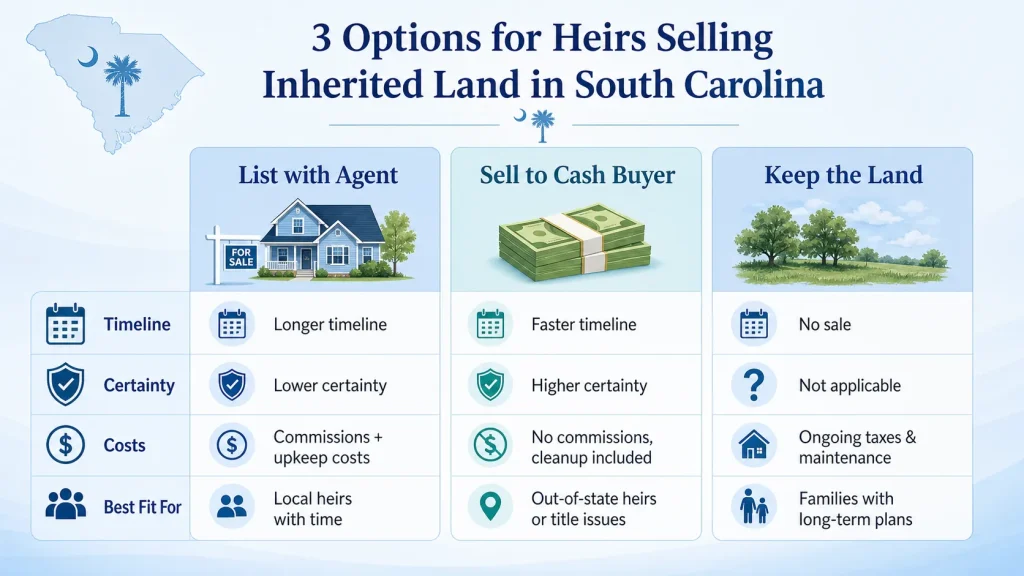
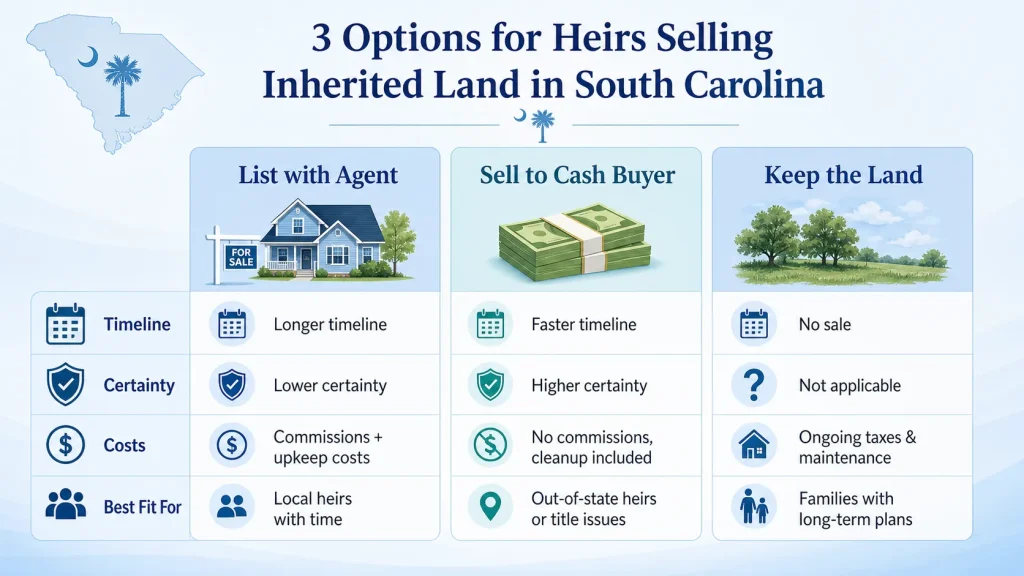
Every family weighs three paths: list it, sell for cash, or hold onto it. There is no single right answer, but the trade-offs are clear. Here is how the three paths compare side by side.
| Option | Timeline | Certainty | Costs | Best Fit For |
| List with an agent | Longer, since land often takes time to match a buyer | Lower, because buyers can back out during due diligence | Commissions plus ongoing taxes and upkeep | Local heirs with time to manage showings |
| Sell to a local cash buyer | Often faster once title is clear | Higher, with no lender approval needed | Usually no commissions, with cleanup priced into the offer | Out-of-state heirs or land with title or access wrinkles |
| Keep the land | No sale | Not applicable | Ongoing taxes, insurance, and maintenance | Families with a shared long-term plan |
Land often takes longer to sell than a house. Comparable sales are scarce, and buyers hesitate over access or utilities. Every extra month adds carrying costs. Rural tracts without utilities can take even longer.
In many cases, a lower cash offer leaves a similar net once you subtract those costs. A listing can still make sense for heirs with time and clean, accessible land. The right choice depends on your family’s patience and budget. Run the numbers before you decide.
There is no one-size timeline, but there is a simple roadmap. Some steps overlap, especially when probate is involved. Most South Carolina heirs follow this order:
1. Confirm what you own and who the heirs are.
2. Talk with an attorney or title professional if anything is unclear.
3. Decide as a family whether to keep, list, or sell for cash.
4. Gather deeds, tax bills, the will, letters of appointment, and trust papers.
5. Sign a listing agreement or a purchase agreement.
6. Let the closing attorney clear title issues, liens, and court approvals.
7. Close and split proceeds according to your agreement.
Clean, non-probate cash sales can often close within weeks once title is clear. Listings and cases with probate or heir disputes can run much longer.
Are tax notices and family debates wearing you down? High Noon Home Buyers buys inherited land as-is across South Carolina, with no repairs and no commissions. Request a no-obligation cash offer, compare it with listing or holding, and choose your path. You pick a closing date that works for your family.
Generally, yes. Every co-owner on title must sign for a voluntary sale. If heirs refuse, a co-owner can file a partition action. That route is usually slow, costly, and stressful, so most families try negotiating first.
Usually only through a partition action, where a judge divides the land or orders a sale. South Carolina’s heirs property law adds protections, such as giving other heirs a chance to buy out shares.
No. Land held in a trust, owned jointly with survivorship rights, or already deeded to heirs may skip probate. A South Carolina attorney can confirm how your parcel is titled and which path applies.
South Carolina has no estate or inheritance tax. Federal capital gains tax may apply, but the stepped-up basis often reduces it. Closing costs and any back property taxes also come out of proceeds.
Often, yes. The closing attorney can usually pay delinquent taxes and agreed liens from the sale proceeds. Bigger title problems, like missing heirs or very old deeds, may need attorney help before closing.
No. We buy inherited land as-is and handle brush, old sheds, and junk removal after closing. That saves time and money, especially for heirs who live out of state or are stretched thin.