

If your parents recently moved into assisted living, you’re probably standing in their empty Tuscaloosa house right now, surrounded by decades of belongings, trying to figure out what comes next. Should you sell it? Rent it out? Just let it sit for a while until you have more time to think? On top of all that, you’re juggling care costs, family opinions, and a stack of paperwork you didn’t ask for.
This guide is here to help you make the decision about selling a Tuscaloosa house after a parent moves to assisted living. We’ll walk through how to weigh selling against renting or holding, what legal and tax basics matter for Alabama families, and a checklist that fits around caregiving rather than competing with it.
We’ll also look honestly at how a cash offer compares to listing with an agent, so you can pick what actually fits your family’s situation. This is educational information, not legal, tax, or financial advice, but it should give you a clearer head before you make any calls.
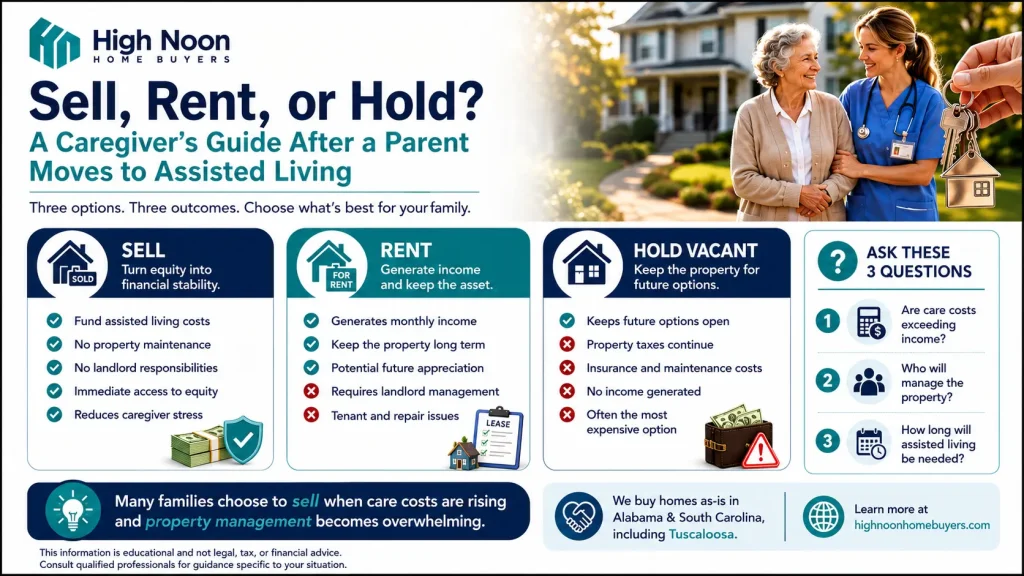
This usually comes down to three honest questions: What is the house costing you every month it sits there? Who in the family actually has the time to manage it? And how long is this care situation expected to last?
Selling tends to make sense when the cost of care is outpacing your parent’s income and savings, no one in the family has the time or energy to take on landlord duties while also managing caregiving, the house needs repairs nobody is in a position to fund or oversee right now, or a lump sum would genuinely take some financial pressure off the family.
Renting can work, but be honest with yourself about what it actually involves. It sounds appealing on paper, a little extra income, keeping the house in the family. But renting means tenant calls, repair requests, and ongoing management, on top of everything else you’re already carrying. It tends to make more sense when the home is in good shape, a family member or property manager can reliably handle it, and you want to hold onto the asset for the long term.
Holding the house vacant rarely makes sense beyond a short transition window. Property taxes, insurance, and maintenance keep adding up with nothing coming in to offset them, and an empty house brings its own risks.
For a lot of families, selling ends up being the path that actually reduces stress, it funds care, eliminates the carrying costs, and takes one more decision off your plate during an already heavy time. If there’s significant equity in the home or Medicaid is part of the picture, it’s worth looping in a financial planner or elder-law attorney before you commit to anything.
There’s no single right answer here, it depends on how much time, energy, and bandwidth your family actually has.
A cash offer from an investor typically means selling the house as-is, no staging, no repairs, no parade of showings while you’re also managing your parent’s care. Closings tend to move quickly once paperwork is in order, and there’s far less back-and-forth scheduling. If the house needs real work and your family is already stretched thin, this route can take a lot of pressure off.
Listing with a traditional agent can bring in a higher price, especially if the home is well-maintained and in a desirable area. But it also comes with commissions, inspection contingencies, repair negotiations, and more coordination, showings, contractor bids, lender timelines, all of which take time and attention you may not have right now.
If speed and peace of mind matter more to you than squeezing out every possible dollar, a cash offer is often the more practical fit during an active caregiving season. If the home is in good condition and you genuinely have the time and energy for the process, listing may bring better proceeds. Be honest with yourself and your family about which one you actually have the capacity for.
Selling a parent’s home in Tuscaloosa is governed by Alabama law, not the rules of any other state. Alabama has its own probate procedures, title transfer rules, and tax framework, so it’s worth working with a local elder-law attorney or CPA who knows Alabama specifically rather than relying on general or out-of-state guidance. The Alabama Department of Revenue is the right place to confirm current state tax rules, and tax law does change, so always check with a qualified professional before making a final decision.
Before anyone talks about prices or closing dates, the family needs to know who is legally allowed to sign for your parents. This single step stops more home sales in their tracks than anything else, so it’s worth sorting out early.
If your parent has a durable power of attorney (POA) that covers real property transactions, you’re likely in good shape; an adult child with a valid POA can typically sign on their behalf without much added complication.
If there’s no POA and your parents can no longer make these decisions themselves, the family may need to go through the courts for guardianship or conservatorship. This adds real time, often months, so it’s better to find out early than to discover the gap once you’re already trying to close.
If your parent has passed away, the executor or personal representative handles the sale through probate or trust administration. And if the title is still in a deceased spouse’s name with no estate plan in place, expect the closing to wait until the title is cleared.
If Medicaid is involved or might be, know that selling the house turns an exempt asset into countable cash, which can affect eligibility if it pushes assets above the state limit. The rules around look-back periods and exemptions are genuinely complicated, so talk to an elder-law attorney before selling if Medicaid coverage is current or even just a possibility down the road.
This isn’t legal advice, just a heads-up about what to sort out early. For anything specific to your family, a qualified Alabama elder-law attorney is worth the conversation.
Cleaning out a parent’s house is hard in a way that has nothing to do with logistics. Take it slow where you can, and don’t feel like you have to handle everything in one exhausting weekend.
Start by setting aside what matters most: important documents, medications, and family keepsakes, things you don’t want to risk losing in the shuffle. After that, a few practical steps go a long way: clearing out general clutter, fixing obvious safety issues like loose railings or a smoke detector that’s stopped working, and gathering the paperwork you’ll need regardless of how you sell, the deed or title, mortgage statements, property tax bills, insurance policy, and any HOA documents or past inspection reports.
You can skip full staging and most cosmetic repairs, especially if you’re selling as-is to an investor. Even with a traditional listing, focus your energy on safety and habitability, not appearances.
If showings are part of your path, schedule them in blocks rather than answering calls all day, and a lockbox can save you from needing to be present every time. Most investors buy strictly as-is, so if that’s your route, this whole list gets a lot shorter, mostly just the documents and the legal pieces, which matter no matter how you sell.
Here’s the short version: what you might owe depends on the home’s tax basis (generally what was paid for it plus the cost of improvements), how long your parents owned and lived in it, and whether it qualifies as a primary residence.
Many homeowners qualify for a federal capital gains exclusion if they meet the ownership and use tests for a primary residence, up to $250,000 for a single filer or $500,000 for a married couple filing jointly. That exclusion applies to the person on the title, so if you’re selling on your parent’s behalf, whose name is on the deed and how long they lived there both matter. The IRS guidance on selling a home covers the federal rules in more detail.
Alabama has its own state tax treatment, separate from federal rules, so don’t assume what applies elsewhere applies here. A local CPA or tax advisor can walk you through exactly what your family will owe, if anything, before you get to the closing table.
Families under financial and emotional pressure are unfortunately a target for buyers who don’t have your best interests in mind. You deserve time to review everything carefully before signing anything, no exceptions.
Be cautious of anyone pushing you to sign immediately, refusing to put their full legal name or company name in writing, or sliding language into the contract that lets them assign the deal to someone else without telling you. If what’s offered verbally doesn’t match what’s written down, or if anyone asks for money upfront just to make an offer, that’s a sign to step back.
A legitimate buyer will give you their full legal name or entity name in writing, a clear purchase price and closing timeline, proof of funds or pre-approval if you ask for it, and time for an attorney to review the contract before you sign.
One trap worth knowing about: some agreements that look like a standard purchase contract are actually option or marketing agreements, giving the buyer control of your property without ever committing to actually close. A real estate attorney reviewing the contract before you sign protects you here, no matter how straightforward the deal seems.
This doesn’t all need to happen in one weekend, or even one month. A phased approach keeps things manageable alongside everything else you’re carrying.
First 30 days: Confirm who has legal authority to sell, a valid POA, guardianship order, or executor status. Talk with your parents and family about the decision, if that conversation is possible. Gather the core documents: deed, mortgage statements, tax bills, insurance, HOA paperwork, past inspections. If Medicaid is involved or legal authority is unclear, this is the time to call an elder-law attorney.
Days 30 to 60: Weigh a cash offer against listing with an agent. Order any inspections or legal reviews you need. Handle the essential decluttering and basic safety items. If you’re listing traditionally and repairs are needed, get contractor estimates.
After an offer is accepted: Schedule closing with a licensed title company or real estate attorney. Coordinate the move-out date and transfer of possession. Take care of final utility readings, mail forwarding, and canceling local services. If a Medicaid spend-down or trust is involved, make sure the proceeds are directed correctly.
A cash sale can simplify a lot of this, fewer showings, no repair bids, a faster close, but the legal and tax pieces still matter no matter which path you take. Keep a simple written list of action items and deadlines so nothing slips through during an already full season of life.
Do I owe capital gains tax when selling my parent’s house to pay for assisted living?
You might, if the sale price is more than the home’s tax basis, but many families qualify for a federal exclusion if the ownership and use tests are met for a primary residence. How much, if anything, you’d owe depends on how long the home was owned, whether it was a primary residence, and Alabama’s specific rules. A CPA can give you the real number before closing.
Do I have to sell my parent’s house once they move to assisted living?
No. There’s no legal requirement to sell. Many families do, to help fund care, but renting, holding the home, or folding it into an estate plan are all options too. If Medicaid or estate planning is part of the picture, those should be reviewed with a professional before deciding.
Could selling the house affect Medicaid eligibility?
Yes, it can. Selling turns an exempt asset into countable cash, and if that pushes total assets above the state limit, it can affect eligibility. Look-back periods and exemptions are involved, so talk to an elder-law attorney before selling if Medicaid coverage is current or might be needed soon.
What’s the real difference between a cash offer and listing with an agent when I’m also caregiving?
A cash offer trades some potential sale price for speed, certainty, and an as-is process, which can be a real relief during an active caregiving season. Listing can bring a higher price but takes more time, prep, and coordination. It comes down to how much bandwidth your family actually has right now.
What should I watch out for when selling to fund care?
Be wary of pressure to sign fast, buyers who won’t give you their full legal name in writing, and vague language about assigning the contract to someone else. Use a licensed title company or closing attorney, have a contract reviewed before signing, and never pay an upfront fee just to get an offer.
Selling a Tuscaloosa house after parent moved to assisted living is a lot, emotionally, legally, and financially, all at once. The families who get through it most smoothly are usually the ones who figure out who’s legally allowed to sign early, get a professional’s eyes on the tax and Medicaid questions, and are honest with themselves about how much they can actually take on right now.
If you’re stretched thin between care visits, family calls, and a house that needs dealing with, you don’t have to manage repairs, cleanouts, showings, and negotiations on top of everything else.
High Noon Home Buyers is here for a no-obligation conversation whenever you’re ready, we buy homes as-is in Tuscaloosa and across Alabama, on a timeline that works around your family’s care plans, not the other way around. Reach out to highnoonhomebuyers whenever the time feels right.