
You open the mailbox and find an envelope stamped FINAL NOTICE from your HOA. The balance is more than you can cover this month. Words like collections and lien jump off the page. Now one question keeps you up: what happens if you don’t pay HOA fees in South Carolina or rather, can you lose your home over HOA fees?
Here is the short answer. If you don’t pay HOA fees in South Carolina, late fees and interest usually grow the balance. The HOA can send your account to collections and record a lien against your property. In some cases, it can even pursue foreclosure.
The good news is that you still have options long before a sheriff’s sale. This guide covers missed payments, HOA liens, foreclosure, fees, and the choices you still have. It is general information, not legal or financial advice. For your specific situation, talk with a South Carolina attorney.
HOA fees, also called assessments or dues, are your share of the neighborhood’s shared bills. They are a contractual obligation tied to owning the property, not an optional donation. The power to collect them comes from your recorded covenants, conditions, and restrictions (CC&Rs) and bylaws.
In a Myrtle Beach condo, dues may cover elevator upkeep and building insurance. In a Columbia subdivision, they may fund pond maintenance and shared green spaces. When owners stop paying, the association runs short on money for these jobs. That is why governing documents give HOAs real power to collect.
South Carolina HOAs operate under recorded covenants, contract law, and statutes like the South Carolina Homeowners Association Act. The state Department of Consumer Affairs also offers HOA education resources for homeowners. Both are useful starting points before you call a lawyer.
Under that Act, homeowners can generally inspect and copy their association’s annual budget. Reviewing it helps you understand why dues rose and where your money goes. Keep a copy with your closing paperwork and CC&Rs.
Missing one HOA payment rarely triggers a lien overnight. Instead, a predictable sequence usually begins, guided by your covenants and billing policies. Each community sets its own due dates, grace periods, and late fee amounts. Here is how the process typically unfolds:
| Stage | What Usually Happens | Your Best Move |
| Payment marked late | Account shows a past-due balance after the grace period | Pay what you can and call the HOA |
| Late fees and interest | Flat fees, interest, or both stack up each billing cycle | Ask for a written, itemized ledger |
| Reminder notices | Letters or emails warn about collections or an attorney | Respond in writing and keep copies |
| Amenity restrictions | Pool, clubhouse, or gate access may be suspended | Request a payment plan to restore access |
| Formal demand letter | Often sent by the HOA’s attorney with a firm deadline | Get legal advice before the deadline |
Late fees and interest work like a snowball rolling downhill. The longer you wait, the faster the balance grows. Homeowners who respond after the first serious letter usually have far more options.
Honest, early contact often leads to a written payment plan. Silence usually leads to an attorney’s letter instead. Once lawyers get involved, their fees are often added to your balance.
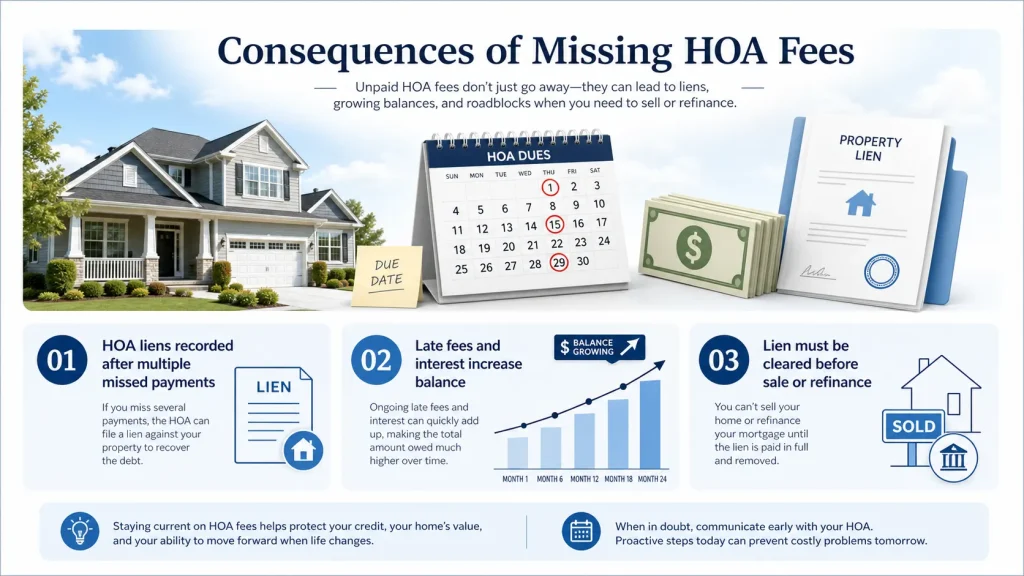
An HOA lien is a recorded legal claim against your property for unpaid assessments and authorized charges. Once filed, it clouds your title and shows up in any title search. It usually must be paid or resolved before you can sell or refinance.
Picture an owner in a Lexington County subdivision who falls behind on dues. The HOA records a lien for assessments plus late fees, interest, and attorney’s fees. At closing, the attorney pulls a payoff and pays it from the sale proceeds. The seller only receives the equity that remains afterward.
Your closing attorney orders the HOA payoff and makes sure the lien is released. Learn more about why you need a closing attorney to sell a house in South Carolina.
Lien priority can get complicated. Property taxes and a first mortgage often rank ahead of the HOA. Our guide to the South Carolina tax sale process explains how unpaid property taxes create separate risks. The exact order depends on your documents and state law, so ask an attorney.
In some situations, yes. A South Carolina HOA may pursue foreclosure based on unpaid assessments, usually as a last resort. It typically follows a significant delinquency, a recorded lien, and court action. Every HOA’s documents and procedures differ, so details vary by community.
• Substantial delinquency: The owner falls well behind, not just one late month.
• Recorded lien: The HOA has already filed its claim in county records.
• Lawsuit: The HOA’s attorney asks a court for permission to foreclose the lien.
• Court process: If the court agrees, a foreclosure sale is scheduled and publicly noticed.
Nolo’s overview of homeowners association foreclosures explains how this power works nationally. Even a small starting balance can grow large once legal fees and court costs pile on. Many HOAs still prefer a payment plan or sale over a long lawsuit.
Your mortgage adds another layer. In many cases, the lender’s lien comes first, so it is paid first from any foreclosure sale. If your lender is also involved, review the full South Carolina foreclosure timeline so you know what to expect.
Selling before a lawsuit is filed can turn a forced process into a controlled decision. You choose the timing, the buyer, and how the payoff gets handled.
You may notice the “other charges” column is now bigger than the dues you missed. Many South Carolina HOAs can add extra charges once an account goes past due. Whether each charge is enforceable depends on your covenants and state law.
| Charge | What It Is | When to Question It |
| Late fees | A flat amount or percentage added each late cycle | The amount exceeds what your documents allow |
| Interest | Charged on the unpaid balance at a set rate | The rate isn’t stated in your covenants |
| Rule violation fines | Per-incident fines for parking, trash, or pets | Fines keep piling up with no clear limit |
| Collection and legal costs | Attorney’s fees and court costs after referral | Your documents don’t authorize these costs |
Imagine a Myrtle Beach condo owner who falls behind for several months. Recurring fees, interest, and legal costs can make the HOA payoff far larger than the original balance. That extra amount comes straight out of the owner’s equity at closing.
Credit damage often follows, too. Many HOAs don’t report to the credit bureaus directly. However, collection accounts and court judgments can appear on your report. Experian explains how collection accounts affect your credit and future borrowing.
Special assessments can add even more pressure. When an association is short on funds, it may levy extra charges on top of regular dues. Missing those payments can trigger the same late fees, collections, and lien process.
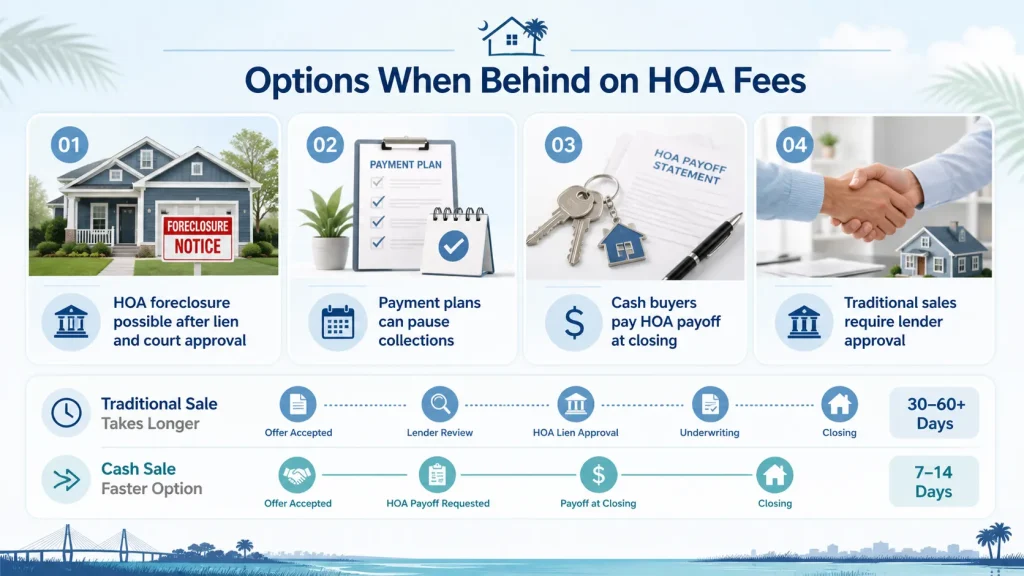
You still have real options if you’re behind on HOA fees in South Carolina. None of them feel easy, but doing nothing is usually the worst choice. The right path depends on your budget, timeline, and the home’s condition.
| Option | Best For | Trade-Off |
| Written payment plan | Short-term hardship with steady income ahead | You must keep every new payment current |
| Dispute improper charges | Ledgers with unauthorized fees or penalties | Takes time and careful documentation |
| Refinance or personal loan | Owners with equity and solid credit | Adds a new monthly obligation |
| Traditional listing | Homes in good shape with time to wait | Repairs, showings, and commissions |
| As-is cash sale | Tight timelines, repairs, or looming foreclosure | Offer reflects repairs and the HOA payoff |
If you receive lawsuit papers or foreclosure threats, get help quickly. A South Carolina attorney can explain your rights and deadlines. You can also find a HUD-approved housing counselor for free or low-cost guidance.
• Inherited condo: An estate falls months behind on condo dues. Selling as-is pays the HOA at closing, so heirs split what remains. Our guide on how to sell heirs property in South Carolina covers the legal side.
• Vacant rental: A Columbia landlord’s tenants leave, repairs pile up, and HOA bills keep arriving. A quick as-is sale clears both problems at once.
• Job loss or medical hardship: Dues fall behind while income drops. Selling before a lawsuit protects the equity that remains.
Focus on what you actually walk away with, not just the sale price. A slower, higher-priced sale can still net less after fees, repairs, and carrying costs. Run the numbers on both paths before you decide which one fits.
In any sale, the closing attorney requests an HOA payoff and pays it from the proceeds. The difference is how much risk and delay you face along the way. With a cash buyer, no lender gets nervous about delinquent dues or an existing lien. That removes one of the most common reasons HOA-related deals fall apart.
| Factor | Traditional Sale | As-Is Cash Sale |
| Lender approval | Required, and HOA liens can stall underwriting | Not needed |
| Repairs | Often expected before listing | Buyer purchases as-is |
| HOA payoff | Paid from proceeds at closing | Paid from proceeds at closing |
| Commissions | Typically paid by the seller | None |
| Timeline | Often months of showings | A firm closing date you choose |
Closing costs still matter when you compare offers side by side. Understanding South Carolina deed stamps and transfer tax helps you estimate your true net proceeds.
If HOA trouble is closing in, High Noon Home Buyers can walk through your situation. There are no commissions, no out-of-pocket closing costs, and no repairs required. A quick conversation shows whether a cash sale leaves you enough to move forward. Even if you don’t sell, you’ll understand your timeline much better.
In some situations, yes. It usually happens only after a significant delinquency, a recorded lien, and court action. Foreclosure is typically a last resort. Talk with a South Carolina attorney immediately if foreclosure language appears in your mail.
There is no single statewide timeline. Your covenants set the grace periods and balance thresholds before a lien is recorded. Most South Carolina HOAs send several notices and a formal demand letter before filing anything.
They can. Many HOAs don’t report directly, but collection accounts and court judgments can appear on your credit reports. That can make future mortgages, refinances, car loans, and other borrowing harder to get approved.
Reasonable late fees and fines are often enforceable when your governing documents authorize them. Open-ended penalties or charges beyond what covenants and state law allow may be questionable. Ask a South Carolina attorney to review any suspicious charges.
Yes, in many cases. The past-due balance or lien is usually paid from the sale proceeds at closing. Your closing attorney orders the payoff and confirms the lien is released before the deed transfers.
Usually not. Reputable cash buyers expect back-due HOA amounts and factor the payoff into the offer. The balance becomes a line item on your closing statement instead of an upfront expense.